Beyond "R U OK?" — What Real Psychosocial Support Looks Like on a FIFO Site
Every September, R U OK Day prompts a wave of yellow cupcakes, morning teas and toolbox talks across mining villages and remote sites around Australia. And that matters — awareness days start conversations that otherwise never happen.
But a FIFO worker's reality is not one day. It's a two-week swing, a 12-hour night shift roster, a crib room full of tired people, and a family at home carrying on without them. If psychosocial support only shows up when the calendar says so, it's not support. It's a poster.
Real psychosocial support on a FIFO site is built into the everyday. Here is what it looks like in practice.
Support That Survives the Whole Swing
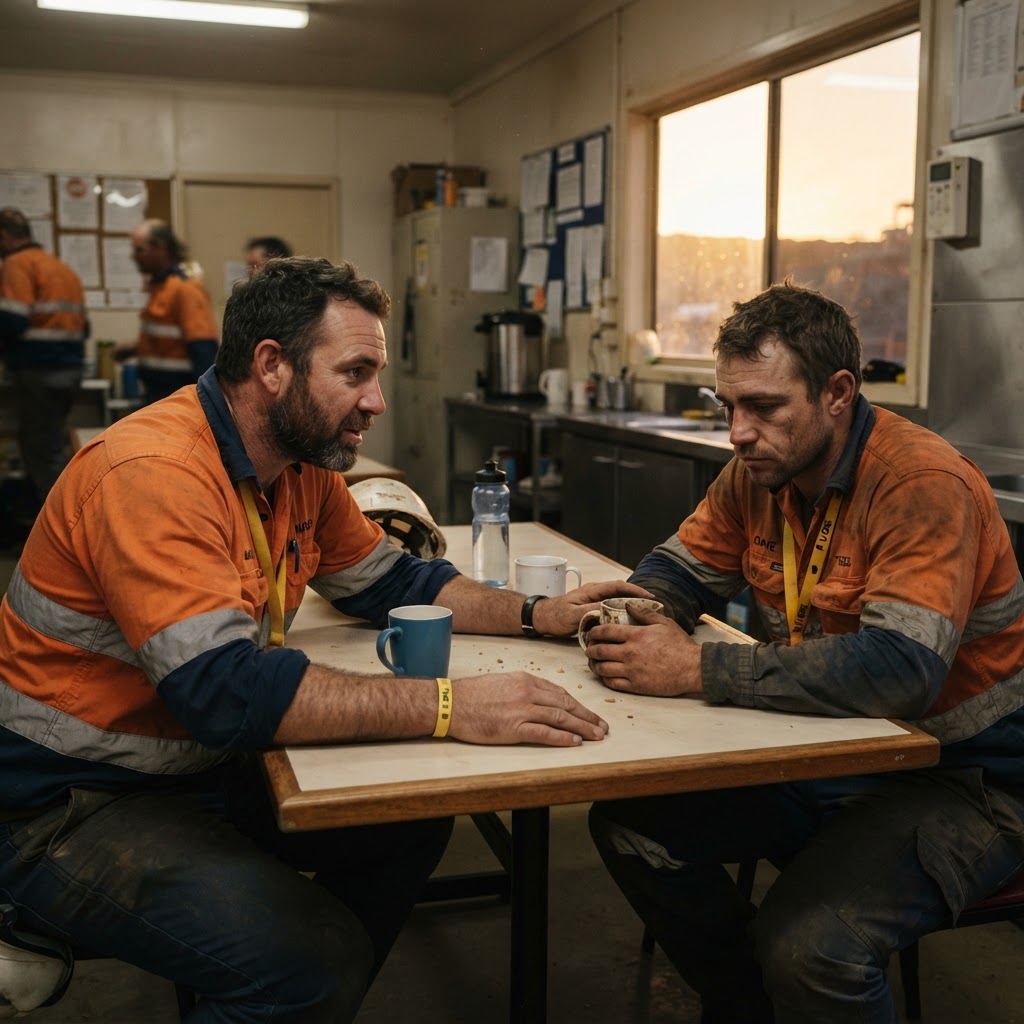
Crib room conversations that go deeper than "she'll be right"
FIFO culture is built on resilience, and that's a strength — until it becomes a mask. Sites with genuine support have crib rooms where it's acceptable to say "this week's been a rough one" without being written off as a whinger or a safety risk.
That kind of culture isn't created by campaigns. It's created when the whole site — supervisors and long-timers included — models it themselves. When a leading hand mentions their own tough phone call home, they give everyone else permission to be human too.
A whole workforce trained to notice, not just supervisors
The people best placed to spot emerging psychosocial risk are not the EAP provider on the other end of a phone line, and they're not only the supervisors — they're the people who work alongside each other every day. The tradie who's gone quiet. The operator who's suddenly calling in fatigued. The team member whose performance dropped after a roster change. These signals show up in the day-to-day, long before they reach a report or a leader's inbox.
That's why workforce-wide psychosocial risk training matters. When an employer trains its entire workforce — not just supervisors and site leaders — to recognise the early signs of isolation, fatigue, roster pressure, relationship strain and withdrawal, the whole site becomes an early-warning system. Every worker knows what to look for, what to say, and where to point a mate who's doing it tough. Supervisors still play a critical role in responding, but awareness shouldn't wait for a leader to notice: it should live with everyone.
Mates who know how to ask twice
"You right?" followed by "yeah, all good" is where most conversations end. Real peer support means knowing how to ask twice — because the honest answer rarely comes the first time.
It also means knowing where to point a mate beyond yourself. Trained workers are not counsellors, and the goal is not to carry someone else's load. The goal is to bridge the gap between "I've noticed something's off" and "here's someone who can actually help." That bridge is exactly what workforce-wide psychosocial risk training builds.
Why One Day Isn't Enough
Psychosocial hazards in FIFO work don't take the other 364 days off. Isolation, fatigue, roster pressure, relationship strain and reduced access to support are present every swing, every roster cycle, every missed birthday at home.
For organisations, there's also a compliance dimension. Under WHS law, psychosocial risk is a health and safety issue like any other — which means awareness alone doesn't discharge your duty. What regulators and ISO 45003 expect is that awareness connects to something: consultation, reporting pathways, early response, and operational controls that actually reduce exposure.
An awareness day can be a genuine catalyst. But if the cupcakes arrive and nothing changes on day two, workers quickly learn the organisation's commitment is seasonal.
Turning the Day Into a System
If your site marks R U OK Day, use it as a launchpad rather than a standalone event:
- Ask the workers, not just the posters. Run a genuine consultation on what the biggest psychosocial pressures are on your rosters and sites — then publish what you heard and what you're doing about it.
- Train the entire workforce, not just supervisors. When every person on site can recognise early warning signs and knows the escalation pathway, the conversation doesn't dead-end on the day itself — and awareness doesn't depend on a leader happening to notice.
- Keep the pathways visible year-round. EAP details, peer contacts and reporting options belong in inductions, crib rooms and pre-starts — not just on a September poster.
- Review the hard data. Absenteeism, fatigue reports, turnover, incident near-misses: these are your psychosocial indicators. Look at them monthly, not annually.
The Bottom Line
R U OK Day is a good reminder, not a strategy. For FIFO and remote workforces, real psychosocial support is measured in everyday habits — conversations that go deeper, a workforce that notices early, and mates who follow up. That's what turns a calendar event into a culture, and culture is what actually protects people.
If your organisation is reviewing how psychosocial support works across your remote sites, FIFO Mind Connect trains the entire workforce — not just supervisors — in practical psychosocial risk awareness, so every person on site can spot the signs early and know what to do next.
Share this insight