
Financial Pressure Does Not Stay at Home
When interest rates rise, the conversation usually focuses on mortgages, repayments, inflation, household budgets and the broader economy.
That matters.
But in FIFO and remote workforces, financial pressure does not stay neatly at home.
It can come onto site through:
- poor sleep
- distraction
- irritability
- relationship strain
- fatigue
- reduced patience
- increased conflict
- workers pushing through when they are not coping
- fear of losing income
- reluctance to speak up because the job feels too financially important to risk
This is where the link between financial stress and psychosocial risk becomes important.
The issue is not that the RBA, mortgage rates or household bills are workplace hazards in themselves.
The issue is that external financial pressure can amplify existing workplace psychosocial risks.
In FIFO work, those existing risks are already well known.
Workers are away from home.
They may be isolated from family and support.
They may be working long hours.
They may be living where they work.
They may be dealing with fatigue, roster pressure, camp culture, relationship strain and limited privacy.
Add financial pressure to that mix, and the risk profile changes.
What Is Psychosocial Risk?
Psychosocial risk is the risk of psychological or physical harm arising from the way work is designed, managed, supervised or experienced.
Safe Work Australia identifies psychosocial hazards such as:
- high job demands
- poor support
- low job control
- poor organisational justice
- lack of role clarity
- remote or isolated work
- harmful behaviours
- poor physical environment
- inadequate reward and recognition
- bullying
- harassment
- violence and aggression
- traumatic events or material
For FIFO workers, several of these hazards can exist at the same time.
That matters because psychosocial hazards rarely operate in isolation. One hazard can increase the impact of another.
For example, remote or isolated work may be harder to manage when there is poor support. Fatigue may become more dangerous when a worker is distracted. Relationship strain may become worse when a worker is away from home and under financial pressure.
That is the real issue.
Financial stress can act like fuel on an already loaded system.
The FIFO Financial Trap
The FIFO Financial Trap
FIFO workers are not the only people dealing with mortgage stress, rising costs or household pressure. Many workers outside the sector are facing the same challenges, often on lower incomes.
The FIFO difference is not simply the amount earned.
For some workers, especially younger people entering high-paying roles for the first time, increased income can quickly become tied to larger financial commitments. Vehicles, property, debt, family expenses and lifestyle expectations can all grow around the assumption that FIFO income will continue.
That can create a form of pressure that is easy to miss.
A worker may be earning well but still feel financially trapped. They may think:
- “I just need to get through this swing.”
- “I cannot afford time off.”
- “The mortgage depends on this job.”
- “If I speak up, they might think I am unreliable.”
- “My family needs the money.”
- “I will deal with it when I get home.”
Then they get home and the home pressure starts.
Bills. Relationship strain. Parenting. Repairs. Catching up. Trying to reconnect. Trying to rest. Trying to be present.
Then they fly back out and do it again.
For employers, the issue is not judging personal financial choices.
The issue is recognising that financial pressure can interact with fatigue, isolation, roster stress and relationship strain, then show up on site through behavioural change, distraction, conflict or reduced capacity.
This is not weakness.
It is an operating reality that employers need to understand.

Financial pressure often follows FIFO workers from home to site, affecting sleep, focus and capacity during a swing.
Why Interest Rate Pressure Matters for FIFO Employers
Interest rate rises can increase mortgage repayments and broader financial strain for households.
For FIFO workers, that pressure can become more than a private finance issue when it starts affecting how someone presents at work.
A financially stressed worker may be:
- sleeping poorly
- distracted during critical tasks
- more reactive in conversations
- less patient with teammates
- more likely to isolate
- more likely to push through fatigue
- less likely to ask for help
- more worried about job security
- more likely to hide personal problems
- more vulnerable to conflict or poor decision-making
That does not mean every worker under financial pressure is unsafe.
It does mean financial stress can reduce capacity.
And when capacity drops inside a high-risk work environment, employers should pay attention.
Financial Stress Is Not the Hazard — But It Can Amplify the Hazard
This distinction matters.
A business is not responsible for every private financial decision a worker makes.
A site manager is not responsible for a worker's mortgage, car loan or household budget.
But employers are responsible for managing workplace risks that are reasonably foreseeable.
If a FIFO workplace already exposes workers to remote or isolated work, fatigue, high demands, poor support, roster pressure or harmful workplace behaviours, then financial stress can make those risks harder to manage.
The better framing is this:
That is the mature argument.
Not political.
Not emotional.
Not blaming the RBA.
Not pretending employers control the economy.
Just practical risk management.
What the Research Says About FIFO Worker Distress
Research published in the Medical Journal of Australia found that 28% of surveyed remote mining and construction workers had high or very high psychological distress.
The same study identified common stressors including:
- relationship problems
- financial stress
- shift rosters
- social isolation
- missing special events
That is important because it shows financial stress is not a fringe issue in remote work.
It sits alongside other known pressure points in FIFO life.
Relationship strain.
Roster pressure.
Isolation.
Financial stress.
Psychological distress.
That combination should get the attention of HSE teams, HR teams, operations leaders and site managers.
How Financial Stress Can Show Up on Site
Financial stress does not always look like someone openly saying they are worried about money.
Often, it shows up sideways.
Supervisors and teammates might notice:
1. Fatigue
The worker may not be sleeping properly. They may be lying awake thinking about bills, mortgage repayments, debt, family pressure or whether they can keep up financially.
On site, that may look like:
- tiredness
- slower reactions
- forgetfulness
- reduced attention
- low energy
- more mistakes
- reduced patience
2. Irritability
Stress often shortens the fuse.
A worker under financial pressure may react more strongly than usual to normal workplace friction.
That might look like:
- snapping at others
- taking feedback personally
- getting defensive
- clashing with supervisors
- escalating minor issues
- becoming harder to communicate with
3. Withdrawal
Some workers go quiet when they are under pressure.
They may stop socialising, avoid the dining room, isolate in their room or stop joining normal conversations.
That might look like:
- reduced communication
- avoiding teammates
- sitting alone
- skipping activities
- becoming unusually flat
- not acting like themselves
4. Distraction
Money pressure can take up a lot of mental space.
The worker may be physically on site but mentally somewhere else.
That might look like:
- loss of focus
- missed details
- lower task engagement
- reduced situational awareness
- appearing checked out
- forgetting instructions
5. Overworking or refusing to speak up
This one is easy to miss.
Some workers under financial pressure do not slow down. They push harder.
They may accept extra shifts, avoid reporting fatigue, ignore signs they are struggling or refuse to raise concerns because they fear being seen as unreliable.
That can create risk.
Not because the worker is weak.
Because the worker feels trapped.
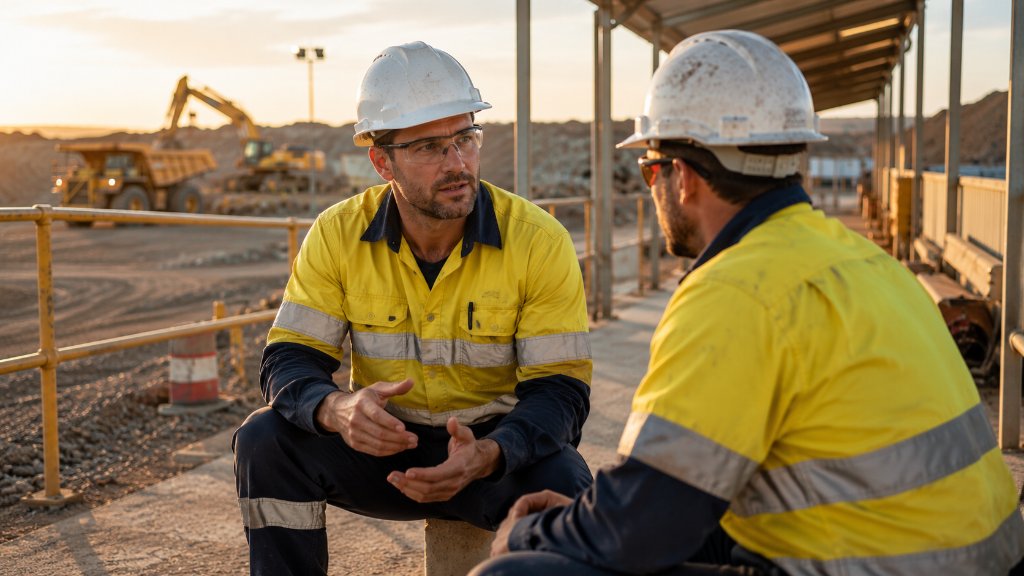
Behavioural change should not be dismissed as attitude. Early, respectful check-ins help supervisors respond before pressure escalates.
Why "Just Call the EAP" Is Not Enough
An Employee Assistance Program can be valuable.
But in FIFO environments, it is usually not enough by itself.
Why?
Because the worker has to:
- recognise they need help
- trust the service
- believe it is confidential
- find the time and privacy to call
- feel their issue is serious enough
- overcome stigma
- take action while potentially exhausted, isolated or ashamed
That is a significant ask for someone who may already be running on empty.
And in FIFO environments, where the culture has historically valued toughness and self-reliance, those barriers can be even higher.
EAPs work better when they sit inside a broader psychosocial safety system.
Not as the entire system.
What Employers Can Actually Do
This is not about employers solving personal finance problems for workers.
It is about building a work environment where psychosocial hazards are identified, managed and controlled — and where financial stress does not silently add to an already loaded system.
Practical steps include:
1. Train supervisors to notice behavioural changes
Supervisors should know what distress can look like and feel confident to check in — without diagnosing, counselling or overstepping.
2. Build psychosocial risk into site safety systems
Psychosocial hazards should sit alongside physical hazards in toolbox talks, pre-starts, inductions and hazard reporting.
3. Create a culture where asking for help is not a career risk
If workers believe speaking up will cost them their job or their reputation, they will not speak up. That is a cultural and leadership issue, not a worker issue.
4. Review rosters and workload design
High demand, poor control and insufficient rest are known psychosocial hazards. Roster design is a lever employers can pull.
5. Make support visible and accessible
That means more than a poster in the crib room. It means leaders talking about it. Supervisors normalising it. Workers seeing others access support without consequence.
The Bottom Line
Financial pressure is rising for many Australian households.
For FIFO workers, that pressure does not stay at home.
It can show up on site as fatigue, distraction, irritability, withdrawal or silence.
It can amplify existing psychosocial hazards.
It can make already difficult work environments harder to manage safely.
That does not mean employers are responsible for fixing workers' personal finances.
It does mean employers have a responsibility to understand how external pressures can interact with workplace psychosocial risk — and to build systems that can absorb that reality.
FIFO Mind Connect helps organisations do that.
Not through generic wellbeing messaging.
Through structured, practical psychosocial risk education that is built for the realities of remote and FIFO work.
This article is for general informational purposes. It does not constitute legal, psychological or WHS compliance advice. Employers should seek appropriate professional advice for their specific circumstances.
Share this insight