
Psychosocial risk has moved out of the "wellbeing" box
For years, psychosocial risk was treated like a soft workplace issue.
Something for HR.
Something for posters.
Something for awareness days.
Something to talk about once a year when the mental health campaign calendar rolled around.
That approach is getting harder to defend.
Psychosocial risk is now firmly sitting inside workplace health and safety, workers compensation, enforcement, litigation and executive accountability.
This is no longer just about whether an employer "cares."
It is about whether a business can show it has taken practical steps to identify, manage and control psychosocial hazards before workers are harmed.
And that is where a lot of organisations still have a serious gap.
The numbers are no longer easy to ignore
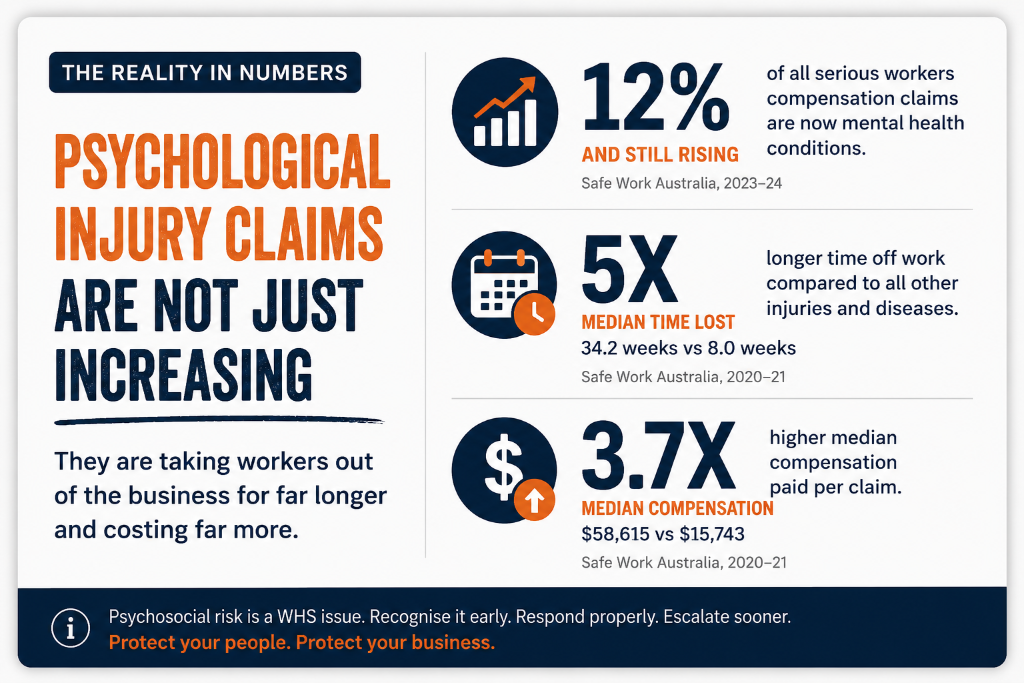
Safe Work Australia's Key Work Health and Safety Statistics Australia 2025 report shows mental health condition claims continued to increase in 2023–24 and now account for 12% of all serious workers compensation claims. The same report states the median time lost from mental health condition claims is almost five times that recorded across all other injuries and diseases.
That is not a small HR inconvenience.
That is lost labour, disrupted rosters, compensation cost, operational drag, management time, legal exposure and damage to workforce trust.
Safe Work Australia's earlier psychological health report also found that, in 2020–21, the median compensation paid for mental health condition claims was $58,615 per serious claim, compared with $15,743 for all injuries and diseases. Median time lost was 34.2 working weeks, compared with 8.0 weeks for all injuries and diseases.
The legal and enforcement signal is getting louder
Employers do not need to panic. But they do need to wake up.
In Elisha v Vision Australia Ltd, the High Court dealt with damages for psychiatric injury connected to breach of contract in an employment context. The case involved an employee who developed major depressive disorder after the handling of a dismissal process. The High Court materials describe the central issue as whether damages for psychiatric injury were recoverable for breach of contract.
That does not mean every psychological injury claim becomes a successful lawsuit.
But it does show something important: psychological harm at work is no longer invisible in the legal system.
There is also a clear WHS enforcement signal.
In December 2025, Comcare reported that the Department of Defence was convicted and fined after admitting it failed to take reasonably practicable measures to eliminate or minimise psychosocial risks relating to the death of a Royal Australian Air Force technician. Comcare described it as the first penalty of its kind for a Commonwealth employer.
That case should make senior leaders uncomfortable.
Not because every workplace is the same.
But because it shows regulators are prepared to treat psychosocial risk as a real WHS issue, not a vague wellbeing problem.
What are psychosocial hazards?
Psychosocial hazards are workplace factors that can cause psychological or physical harm.
Safe Work Australia lists examples including high job demands, poor support, low job control, lack of role clarity, poor organisational change management, poor organisational justice, remote or isolated work, violence, bullying, harassment and traumatic events or material.
In plain English, these are the things in the design or management of work that can wear people down, isolate them, overwhelm them, expose them to harm or leave them unsupported when things start going wrong.
Common psychosocial hazards include:
- high or sustained work pressure
- fatigue
- poor support from supervisors or the organisation
- bullying, harassment or aggression
- unclear roles or constant change
- remote or isolated work
- exposure to traumatic events
- poor communication
- poor conflict management
- low control over work
- lack of recognition or fairness
Safe Work Australia also notes that remote or isolated work can combine with other hazards, such as poor support, and make it harder for workers to access help.
That matters directly in FIFO, mining, construction and remote work.
Because psychosocial hazards rarely show up as neat textbook examples.
They show up as crew tension.
Withdrawal.
Short tempers.
Fatigue.
Relationship breakdown.
Alcohol misuse.
Supervisors carrying too much.
Workers not knowing who to speak to.
Problems being buried until they become incidents.
FIFO and remote workforces cannot treat this as a head office issue
This is where many businesses get it wrong.
They push psychosocial risk into HR, wellbeing or leadership training and assume the job is done.
It is not.
In FIFO, mining, construction and remote environments, the risk often appears closest to the crew, not closest to the boardroom.
By the time HR hears about it, the issue may already be advanced.
That is why workforce-level awareness matters.
A supervisor, leading hand, crew mate, camp manager, contractor or site-based worker may notice early signs before anyone else does.
But noticing is not enough.
They need to understand:
- what psychosocial hazards are
- what early warning signs can look like
- what is and is not their role
- how to respond without making it worse
- when to escalate
- where the business expects concerns to go
- how psychosocial risk fits into WHS, not just "being a good person"
This is the same logic businesses already use for physical safety.
Workers are trained to recognise hazards.
They are trained to stop, report, escalate and control risk.
They are given language and process.
Psychosocial hazards should not be left to common sense.
Common sense is not a control.
| Physical safety | Psychosocial safety | |---|---| | Site induction | Psychosocial risk induction | | Take 5 / StepBack | Early recognition and escalation | | Critical controls | Practical response pathways | | Incident reporting | Psychological hazard reporting | | PPE and procedures | Training, support and role clarity |
The gap employers can no longer ignore
Most large employers already have some form of physical safety induction.
Workers are told about:
- hazards
- controls
- emergency procedures
- reporting pathways
- site expectations
- safety responsibilities
But many of those same workers receive little or no practical induction into psychosocial hazards.
That gap is becoming commercially and legally exposed.
Because if a business can prove workers were trained to identify a dropped object risk, a confined space risk or a vehicle interaction risk, but cannot show workers were trained to recognise psychosocial hazards, the question becomes obvious:
Why was one category of risk systemised, while the other was left vague?
That question will not just come from workers.
It may come from regulators.
Insurers.
Unions.
Clients.
Tender panels.
Lawyers.
Executives.
Families.
The media after something goes wrong.
This is not about turning workers into counsellors
This part matters.
Psychosocial risk training is not about asking workers to diagnose mental health conditions or become informal counsellors.
That would be dangerous and unrealistic.
The point is much simpler.
Workers need to be able to identify workplace psychosocial hazards in the same practical way they identify other workplace risks.
They need enough knowledge to recognise when something is not right, respond appropriately and escalate through the correct channels.
That is not therapy.
That is risk control.
A well-designed psychosocial risk induction should help workers understand:
- the difference between personal stress and workplace psychosocial hazards
- how work design, isolation, poor support, conflict and fatigue can increase risk
- what early signs may look like in a remote or site-based environment
- what to say and what not to say when someone is struggling
- how to escalate concerns without overstepping
- how to protect confidentiality and dignity
- where internal and external supports sit
- what the organisation expects from workers and supervisors
This is practical, site-ready education.
Not a generic wellbeing campaign.
Why posters and awareness days are not enough
Awareness has a place.
But awareness alone is weak.
A poster does not teach a worker what to do when a mate is withdrawing and snapping at people after three bad swings in a row.
A wellbeing email does not help a supervisor manage a crew member who is fatigued, isolated, under pressure and starting to unravel.
A mental health campaign does not give a leading hand the language or process to escalate a concern before it becomes a crisis.
The problem is when businesses mistake awareness for control.
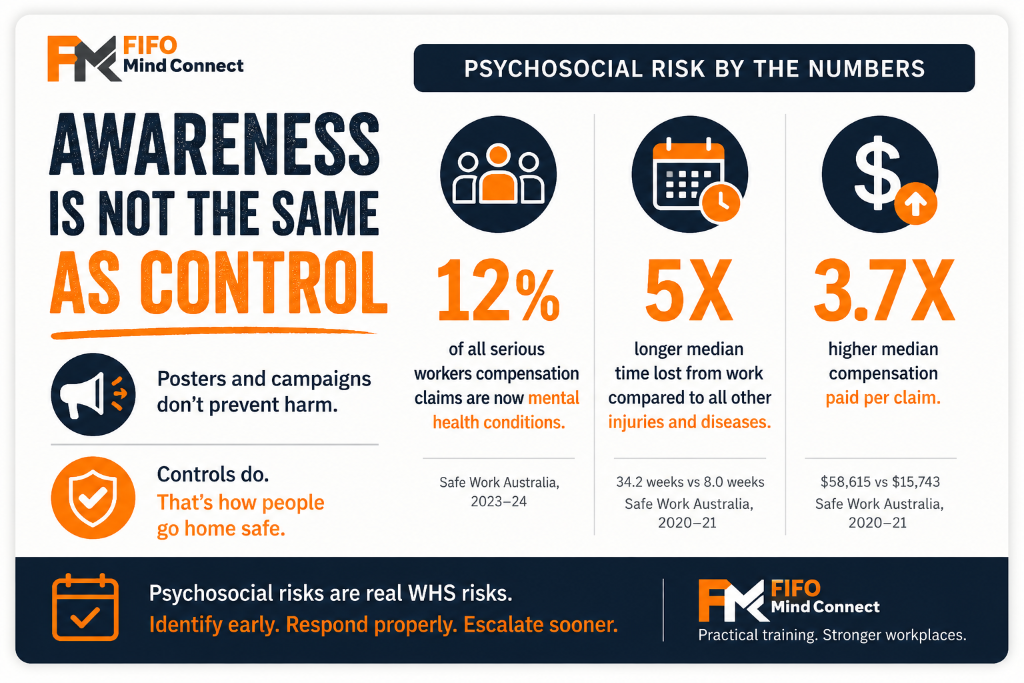
Controls are what keep people safe.
Awareness without controls is incomplete risk management.
And in a WHS context, incomplete risk management is a liability.
What does a practical psychosocial risk control look like?
It looks like this:
Every worker at a site receives a short, practical induction that explains what psychosocial hazards are, how to recognise early warning signs, what their role is, and how to escalate a concern.
It is not a full mental health training course.
It is not a wellbeing workshop.
It is a practical, site-ready induction that gives workers the language and process to recognise and respond to psychosocial hazards, just as they would a physical hazard.
That induction becomes part of the safety system.
Not a one-off campaign.
Not a response to a critical incident.
Part of the system.
Where FIFO Mind Connect fits
FIFO Mind Connect is a psychosocial risk awareness program designed for FIFO, mining, construction and remote workforces.
It is not an EAP.
It is not a counselling service.
It is workforce-level psychosocial risk education that helps businesses demonstrate they have taken practical steps to ensure workers can identify and respond to psychosocial hazards.
It is designed to slot into existing safety systems, site inductions and contractor management frameworks.
It is built for the realities of FIFO and remote work, not a corporate office environment.
If you want to understand how FIFO Mind Connect could work in your organisation, use the enquiry form below.
Share this insight